Swift Land Consulting
A client-centered business that loves the land and a challenge
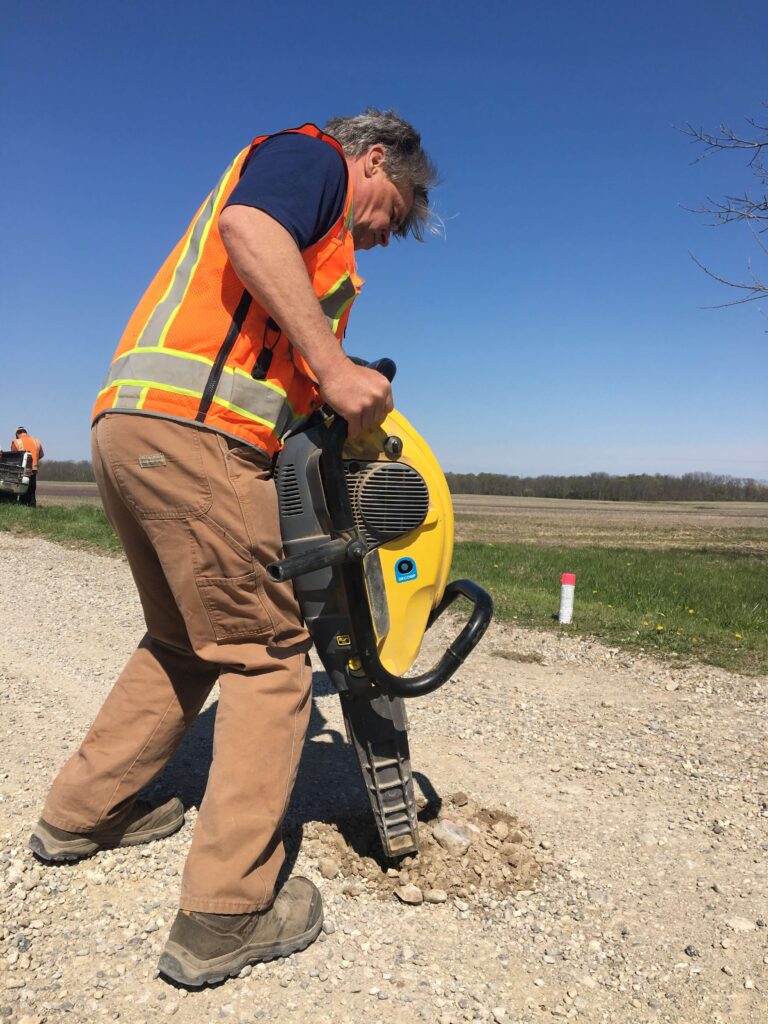 Telling the story of Swift Land Consulting is like tracing the route of one of Jim Swift’s cross-country bicycle trips ventured soon after he graduated from St. Olaf College with a freshly earned degree in history and his flute in his backpack.
There’s always music and a vision there, but it meanders a bit.
“I distinctly remember my first exposure to surveying was in the fifth grade when we learned about George Washington and Thomas Jefferson,” Jim says. “They were surveyors, and in the pictures the teacher showed us there was a tripod.”
“On my way home from school that day I saw a guy surveying in a vacant lot, and he was using a tripod, just like we’d learned in history that day. I thought that was cool.”
Years later during one of the aforementioned bike rides, Jim came across a surveying crew on a road in the wilds of Colorado and stopped and chatted with them.
“I asked them about their work and I thought, I could do this and enjoy it,” he says. “I actually looked up civil engineering companies, thought about trying to get a job surveying then.”
But when he decided to settle down in his hometown of Crawfordsville to be close to family, he returned to house painting and carpentry with a local company to support himself. It was short-lived venture.
“One day I was working on some old fascia at the peak of a really tall barn, and we had scaffolding, but not enough for the job,” Jim recalls. “So I put a ladder up on the scaffolding.
“I had to lean over to pry off that piece of fascia, and when I did, everything tumbled down, and me with it. Somehow, magically, I managed to fling my ladder and myself and spin in the air and land in little pile of hay.
“I was pretty banged up, but I knew the next job would be another accident waiting to happen, and with all these saws around, I’m likely to hurt myself, and if I cut off my fingers, I’ll never play flute again, so I said, ‘Yeah—I’m out.’”
For a while he worked in a local paint shop framing and cutting mattes, but it wasn’t a career.
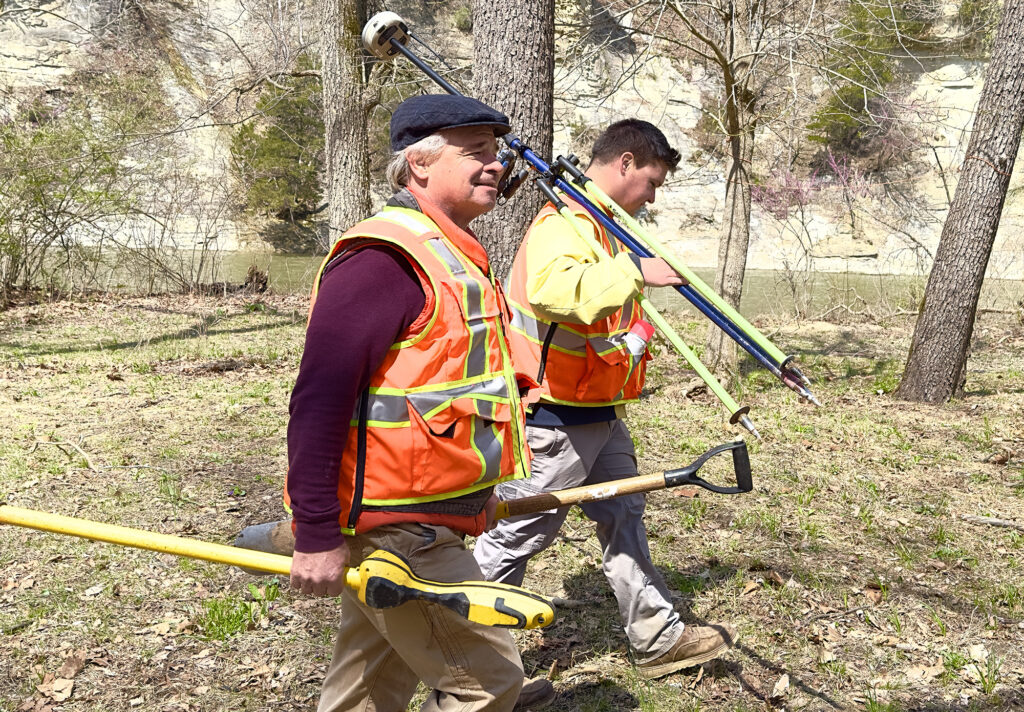 About that time, local surveyor Bill Hudson was looking for office help. He’d convinced Paul Mielke, a retired math professor at Wabash College and the husband of Jim’s former flute teacher, Mary Lou Mielke, to assist him short term. When Paul was finished with that work, he reached out to Jim’s father, also a recently retired math professor at Wabash, to see if he’d be interested.
“My Dad’s response was, ‘I wouldn’t have the least interest in the job,’” Jim says. “Then he added, ‘But my son sure needs one.’”
“My Dad knew surveying, and he knew my math skills would be a good match, and when I talked with Paul Mielke he was so impressed with what Bill was doing. The group had done a four-set-up traverse and closed it to within a ½ inch, and Paul was impressed with the precision.
“I told Bill, sure, I’ll come work for you.”
And so began Jim’s apprenticeship.
“My first job wasn’t as the field guy, but as the office guy who could sit there and think straight, figure out how it all works together,” Jim says. “I distinctly remember the first question I asked him: ‘If I buy two acres of land, and one is flat, and the other acre has a hill on it, do I get more actual land surface with the second acre?’ And he said, ‘Absolutely!”
“From then on, I liked Bill Hudson, and I think he liked me.”
Soon Jim was working in the field, as well, and Hudson and Swift surveyed acres throughout Montgomery County.
“Bill was an excellent teacher,” Jim says. “Later, when I went to Purdue I’d find out that a lot of what Bill had taught me as traditional surveying was actually the law—the right way to do things thanks to a body of civil judgments that have become a body of case law. Bill was already teaching me that, from the very beginning, in his own way.”
Eventually Jim went to work for Don Yount, who had owned his own business and also been country surveyor. There Jim earned the reputation for thoroughness that characterizes his work today.
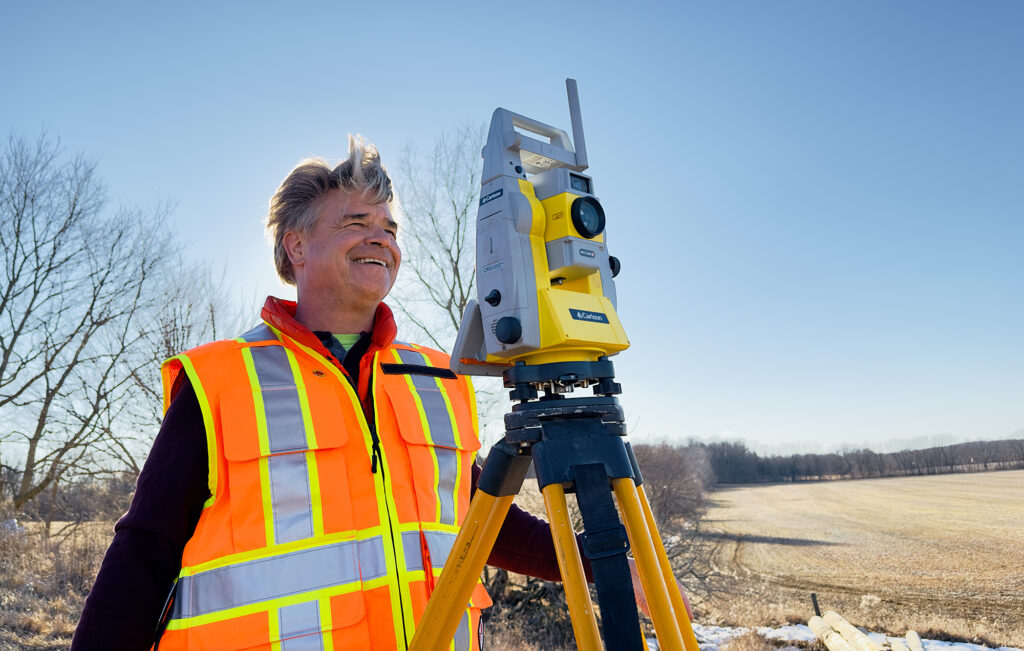
At first it wasn’t so well received.
“I’d write these exhaustive surveyor’s reports on each job, and that’s still a hallmark of me,” Jim says. “But Don used to tell me, ‘You write like a Philadelphia lawyer.’ He didn’t think I needed to be so thorough.
“But I told him, ‘If this survey ever goes to court, you’re going to want it this way, this thorough, with all the detail.’ And eventually he said, “Alright, go ahead and write your Philadelphia lawyer reports.”
The next year Jim enrolled in the Purdue University Engineering Department’s master’s program in Geomatics, completing a one-year-intensive session to get started on a program that he ultimately completed in 2007.
When he returned to surveying work with his Indiana license after that one-year intensive in 2003 he founded Swift Surveys, Inc., and in 2004 his family bought the building at 130 West Main Street where you’ll find Swift Land Consulting today.
Business was brisk for two years but in 2006, Jim could sense the market for surveys was slipping (intuition that proved true when the Great Recession hit in 2008). Just for grins he scanned the job listings in 2006 on the Indiana Society of Professional Land Surveyors web site and he saw that Boone County was looking for a surveyor to find the county’s section corners, the monuments set during the original survey of the United States that mark the corners for a one-mile square of land and are used as a basis for all property descriptions and legal boundaries.
“I thought, oh man—if they want to do this right, that would be an interesting project,” Jim recalls. He met with Boone County Surveyor Kenny Hedge and the seed was planted for what would eventually become his full-time job.
That work combined Jim’s love of history with his vocation as a surveyor and it would define his practice for 10 years, earning him the affectionate nickname “the Boone County Stone Hunter” and establishing a knowledge base and reputation few in the profession in Indiana can match and which surveyors across the state depend upon to this day.
“I learned that I like a big project—something comprehensive I can really sink my teeth into,” Jim says. “And becoming an expert in Indiana studying those old records I learned lot about those surveyors and what they did back in the 1800s. I learned how and why those stones and fence posts were placed where they were; it is all in the old records.
“Studying all that work I learned you’ve got to trust the evidence on the ground.
“I think a lot of office-type surveyors don’t necessarily trust the evidence; they’ll trust some theoretical point. But these stones and the evidence they provide have legal precedence, and that matters.”
The work was lucrative and Jim recalls the time researching, exploring, excavating, and recording the section corners as some of his happiest as a surveyor, and he genuinely liked the people with whom he worked. But he also felt the need for a new challenge.
“I was doing one thing really well, and I didn’t do the other 18 things I used to do,” he recalls. “I didn’t want to be a one-trick pony.”
Jim could also see prospects for surveyors in Montgomery County were improving, so eventually he came to an agreement with Boone County to finish that work on contract while beginning a new business, Swift Land Consulting. Since then, section corners have become less of the work (although his reputation has led to a similar project in Vermillion County) and commercial surveys, minor plats, ALTA surveys and site plans have earned more hours at the business.
Jim’s son, Henry, joined the business in 2018 and is pursuing his surveyor’s license. Matt Hood signed on in 2022 and plans to pursue his license, as well.
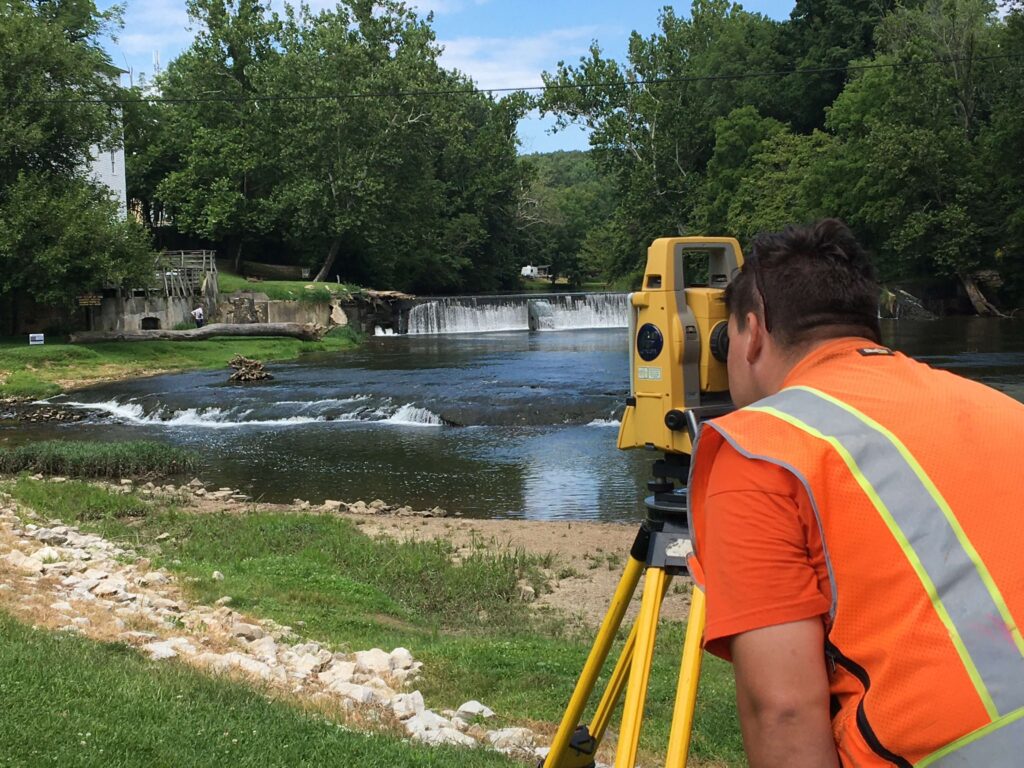 “Matt is better at the more esoteric aspects of surveying, and the more engineering-related work makes more sense to my brain,” Henry says. “We make a great team.”
Niki Hutson joined the team as office administrator in 2024, bringing 25 years of experience in real estate, mortgage, and client relations.
Swift Land Consulting has become a small client-centered business with unlimited capability.
“No surveying challenge is beyond us, given the time and resources to tackle it,” Jim says.
As Swift Land Consulting continues to grow, Jim says trust, good client communication, the quality of the work, and genuine enjoyment of the job will continue to define his business.
“We all have good and bad days, but I truly enjoy what I’m doing,” Jim says. “I think people like to work with me, that they sense a certain empathy and a desire to help.
“I think we’re known for that and the quality of our work. We try to get it right every time. Some surveyors cause as many problems as they fix, but that’s not us.”
He also understands that a lot of people are not well-acquainted with surveys and real estate law, and that education is often a big part of what he does.
“I like it when attorneys call me, because they can trust me,” Jim says. “I’ll never sell somebody on surveying services they don’t need. I limit my services to what is necessary. I think our clients appreciate that.”
“No surveying challenge is beyond us, given the time and resources to tackle it.”